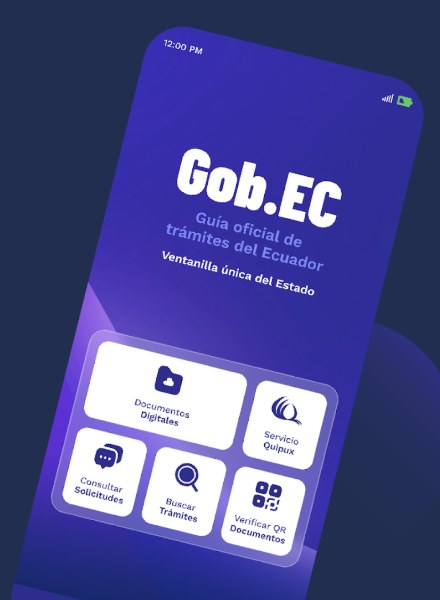
in short
- Ecuador's official national government app, Gob.EC (1,000,000+ installs on Google Play), shipped a full set of production credentials for the country's digital-government platform inside its public Android build.
- The secrets sat in a plaintext configuration file bundled in the app, so every install carried the same keys. Anyone could unzip the app and read them, without an account or any special access.
- We reported it privately on 4 November 2026 to EcuCERT (the national CERT, run by the telecoms regulator ARCOTEL)11, Gobierno Electrónico (the ministry's e-government office) and DINARDAP, the national directorate of public registries12. The report was logged the same day by the government's service desk as ticket REQ 2026-0037966. That was an automated registration, not a reply from a security team.
- A corrected build (v10.2.2) reached Google Play within two days: the store shows us its update date as 6 November 2026. We re-verified on 11 November: the plaintext file is gone and all of the reported secrets are absent from the new build.
- We hope the exposed secrets have also been rotated, but we have not received any confirmation of that.
We are publishing this now, after the client-side fix was verified and after notifying the national CERT, because Gob.EC is the Ecuadorian state's official app: it carries citizens' digital ID and driving licence, and public institutions are required to accept the documents it shows. How that kind of app is built, and how a government responds when something goes wrong, is a matter of public interest. We describe what was exposed and why it mattered. We do not publish the secret values, or anything that would help someone misuse an older copy of the app.
what Gob.EC is
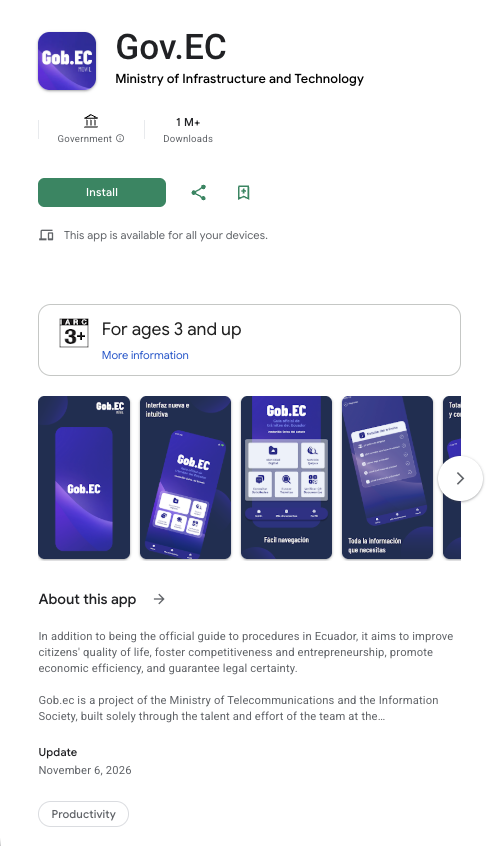
Gob.EC is the single front door to the Ecuadorian state online. It was built by MINTEL, the Ministry of Telecommunications and the Information Society, and launched on 16 June 2020 alongside the government's "Juntos Ecuador" portal; the gob.ec website had gone live the year before, on 28 May 2019.1 At launch the ministry said around 2,500 government procedures could be handled through it.1 Citizens also use it to hold official electronic documents.
The name on the listing has changed since. In June 2026 an executive decree merged MINTEL into the transport and infrastructure ministry, which was renamed the Ministry of Infrastructure and Technology.34 That is the publisher Google Play shows today, while the listing's own description still calls Gob.EC a MINTEL project.2 The current Android listing dates from 20 May 2022.2
It is more than a convenience app. A June 2024 ministerial accord named Gob.EC the state's official app for electronic documents,5 and a March 2025 reform obliged public institutions to accept the documents shown in it.6 The app ties together the core systems of Ecuador's digital state:
- SAU (Sistema de Autenticación Única): the single sign-on that citizens and public servants use, with one username and password, to reach government services.57
- Carpeta Ciudadana: each citizen's folder of official electronic documents, supplied by the institutions that issue them.5
- Identidad Digital (Registro Civil): the civil registry's digital-identity service, which puts the national ID card (cédula) on the phone.8
- Quipux: the government's document-management and official-correspondence system.9
- Licencia Digital: the digital driving licence, issued by the national transit agency (ANT) and shown from inside the app.10
Because one app sits in front of all of these, anything shipped inside it reaches a very large number of people and touches systems that handle identity and official records. That is exactly why it was worth looking at carefully, and why what we found mattered.
what we found
During a static, read-only review of the public Google Play build (verified on 4 November 2026), we found that the app bundled a Flutter environment file, a plain text configuration shipped inside the app's assets, that contained the operating credentials of the digital-government platform. A companion "pre-production" file re-used several of the same values.
We are not publishing the values, the file contents, or the exact identifiers. What matters for the public record is the kind of secret that was present and the service each one unlocked:
- National single sign-on (SAU): a production OAuth2 client secret and client key.
- Carpeta Ciudadana & Licencia Digital (ISO): service-account usernames and passwords, stored in plain text.
- Quipux: an embedded API token for the government document system.
- Identidad Digital (Registro Civil): an embedded client credential.
- GitLab: a personal access token (a developer credential for source-code and CI systems).
- Licence-validation service: a Base64 HTTP Basic credential, used against a bare IP address over unencrypted HTTP, so the data travels in the clear.
- Two private keys (ECDSA) embedded in the app's compiled code, plus a static value related to one-time passwords.
Two properties made this serious rather than theoretical. First, the secrets were the same in every install. They identified the app, not the user, so one download handed someone the whole set. Second, several of them were production credentials for interconnected national systems. In secure-coding terms this is a textbook case of use of hard-coded credentials (CWE-798), compounded by cleartext transmission (CWE-319) on the licence service. We rated it critical at the time of reporting and left the final severity, and the true reach, to the systems' owners. That is the honest position, because only they can see what each credential is actually allowed to do server-side.
why it mattered
We did not use any of the credentials, authenticate to any system, or send a single request to Ecuadorian infrastructure. So everything here is potential impact: what the exposure could have allowed. That is the right way to reason about a leak you have not exploited.
Taken together, the exposed set could have let an unauthorised party, depending entirely on each system's server-side controls:
- Impersonate the Gob.EC app to the national SSO. An OAuth2 client secret is how a service proves it is itself. In the wrong hands it can be used to pose as the official app when talking to the single sign-on that fronts government identity.
- Reach back-office document and identity systems (Carpeta Ciudadana, Quipux, the Registro Civil identity service) through the exposed service-account passwords and API tokens, to whatever extent those accounts were permitted to act.
- Touch developer infrastructure. A GitLab personal access token can expose source code and CI pipelines within the token's scope, and source code often leads to more secrets.
- Intercept or tamper with licence-validation traffic, because it ran over plain HTTP with a static credential.
The common thread is that these are the kinds of credentials that are supposed to live on servers the government controls, not inside an app that a million people carry in their pockets. The point of responsible disclosure here was never to prove any of this by doing it. It was to get the keys changed before anyone did.
how it was handled
The record here is worth telling honestly, because it is mixed. A corrected build shipped within two days, so the people who maintain the app clearly saw the report and acted on it. But the only acknowledgement we ever received was an automated service-desk ticket; no security or incident team replied to us directly.
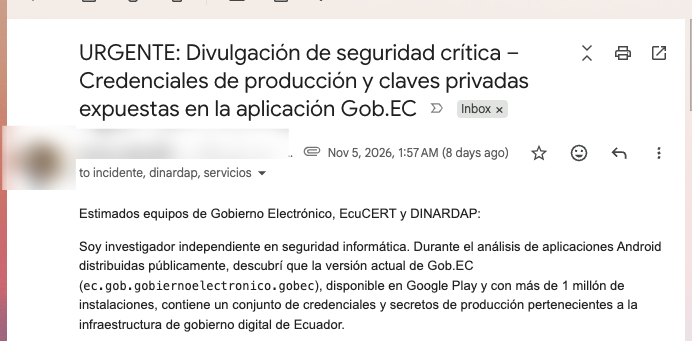
Shipping a client-side fix within two days is a good outcome, and we want to recognise it. But a fast patch is not the same as engagement: no incident team replied to us.
the takeaways
This was not an exotic flaw. It is the single most common serious mistake we see across the apps we scan, and the fixes are well understood:
- A mobile app cannot keep a secret. Anything shipped inside it (config files, compiled code, resources) is readable by anyone who downloads it. Production secrets do not belong in the client.
- Use a public OAuth client with PKCE. Mobile apps should be registered as public clients and use PKCE (RFC 7636); a confidential client secret must never ship in a distributed app.
- Broker privileged calls through a backend. Integrations with document, identity and source-control systems belong on a server you control; the app should only ever receive short-lived, narrowly-scoped user tokens.
- Everything over HTTPS. No credential, and no user data, should travel over plain HTTP.
- Scan builds before release. Automated secret scanning (such as Gitleaks or TruffleHog) in the build and CI pipeline catches this class of mistake before it reaches a store.
method & ethics
Everything here came from static, read-only analysis of the public Google Play package: we downloaded the app, unpacked it, and read what was inside. We did not use any credential, authenticate to any system, or send any request to Ecuadorian government infrastructure. The analysed app was preserved locally so its SHA-256 hash and the findings can be verified independently.
We reported privately and first, gave the authorities time to fix the issue, and re-verified the fix before writing anything public. This account is published after the client-side remediation was confirmed, having reported the issue to and notified the national CERT (EcuCERT), and it deliberately omits the secret values, the file contents and anything that could help someone misuse an older copy of the app. If you believe anything here is inaccurate, or you are a system owner who wants a detail corrected, write to us. If you would like to support this independent research, you can buy me a coffee.
sources
Everything we say about the app, the ministry and the institutions comes from public sources, listed here so each statement can be checked. The findings themselves come from our own analysis of the public build, described under method & ethics.
- Primicias, "Gobierno presenta dos herramientas que buscan mejorar la atención pública". June 2020. The launch of the app on 16 June 2020 with Juntos Ecuador, the figure of around 2,500 procedures, and the gob.ec website's launch on 28 May 2019.
- Google Play, Gob.EC (ec.gob.gobiernoelectronico.gobec). The app's public listing: publisher, category, download count, version, release and update dates, and description.
- Primicias, "Daniel Noboa decreta fusión de Telecomunicaciones con Transporte, ahora se llamará Ministerio de Infraestructura y Tecnología". June 2026. The merger of MINTEL and the new ministry's name.
- Lexis, "Presidente Noboa fusiona seis instituciones en tres nuevos ministerios mediante Decretos Ejecutivos Nos. 425, 426 y 427". June 2026. Executive Decree 426, the merger by absorption.
- Acuerdo Ministerial MINTEL-MINTEL-2024-0017. 27 June 2024, published in Registro Oficial Suplemento 597 on 10 July 2024. Names Gob.EC the official app, and sets out how it uses the SAU and the Carpeta Ciudadana. Copy hosted by the Registro Civil.
- Acuerdo Ministerial MINTEL-MINTEL-2025-0004. Published 31 March 2025. Reforms the 2024 accord so that institutions must accept the electronic documents shown in the app. Copy hosted by Asobanca.
- Resolución 003-NG-DINARP-2022. The operating rules of the Sistema de Autenticación Única (SAU), issued by the public-registries directorate. Copy hosted by Asobanca.
- Resolución 009-DIGERCIC-CGAJ-DPyN-2023. The civil registry's resolution creating the digital ID card service, as a pilot, on Gob.EC. Copy hosted by Asobanca.
- gob.ec, Acuerdo 718: instructivo para normar el uso del sistema de gestión documental Quipux. The instruction governing the use of Quipux across the central public administration.
- gob.ec, Licencia Digital. The official page for the digital driving licence.
- ITU, "EcuCERT" (2014). ARCOTEL's incident response centre, presented as Ecuador's national CSIRT.
- gob.ec, Dirección Nacional de Registros Públicos. The directorate known as DINARDAP until a 2021 law renamed it; it now signs as DINARP.